Word Work Wednesday Linky

My friend Maggie over at Maggie's Kinder Corner is hosting an ongoing weekly linky party for Word Work Wednesdays! I'm joining it today to talk about sight words!

http://maggieskindercorner.blogspot.com/2015/07/word-work-wednesday-linky.html
There are tons of different opinions on how many sight words to teach, in what order, when to start teaching them etc. Personally, I believe that students need to know all of their letters and sounds before starting on sight words. There just isn't enough visual dissimilarity between a lot of sight words for students to correctly memorize them without having letter recognition.

Once students are ready for sight words, I find that they learn best with their peers. A few students are motivated enough to learn sight words from a list at home, but those are not the majority. The rest need lots of playful repetition - through songs, chants and games.

YouTube has a ton of sight word videos - its just a matter of finding ones with the words you need.


HeidiSongs and Dolch Dogs are also good resources for sight word songs!

Once of my students' favorite games to play with sight words is always Hide N Seek. You can play this with practically any concept, so once they know how to play, I just change out the cards throughout the year and they practice that skill, or a new skill, without me having to spend more time teaching game play!

The basic premise is super simple - the sight word cards are arranged in a pocket chart, face up. One student hides a small picture behind a card while the other students close their eyes. Then they have to "find" the small picture by guessing which card it is hidden behind. They can't just point, they have to read the word or the Hider won't turn the card around. Since this can be played in small group, there is always someone who can reinforce a word or correct a misread word. And I make multiple picture pieces so that game play can be extended - if they have to find all 3 pictures they generally read a ton of words before they find them all!


Generally, I  group together students who are within a few Dolch Word Lists of each other. I use the Dolch Word Lists because there are so many resources for it, as compared to the sight word list my school uses. The two word lists have almost exactly the same words, except in different order, so if students master the Dolch Word Lists, they can generally read all the other sight word lists out there!

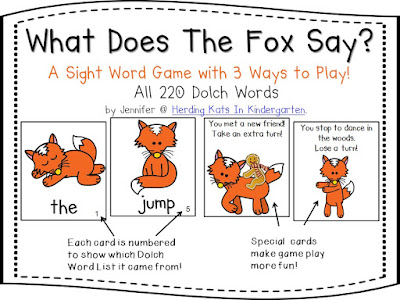
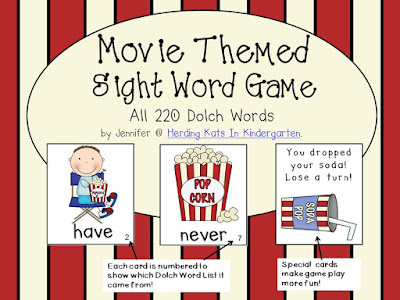
I've created many different themed sets of Sight Word Games. Each time I change out the cards, my students act like its a totally new game and enthusiasm revs up! Here are some of the different theme I have - check out my TPT store for more!
https://www.teacherspayteachers.com/Product/Super-Hero-Superhero-Sight-Word-Game-Dolch-Word-Lists-1-11-802321

https://www.teacherspayteachers.com/Product/Frog-Pond-Sight-Word-Game-Dolch-Word-Lists-1-11-1798466

https://www.teacherspayteachers.com/Product/What-Does-The-Fox-Say-Sight-Word-Game-Dolch-Word-Lists-1-11-1041302

https://www.teacherspayteachers.com/Product/Movie-Themed-Sight-Word-Game-Dolch-Word-Lists-262154

Playing games, watching videos and singing chants helps my students learn the sight words in ways that are engaging and fun! Plus, I don't have a ton of worksheets to grade or papers to copy! Just create the game and let them play!When I do my required sight word assessments, I always see growth, so I can justify letting my students play games rather than tracing worksheets!

I hope that gave you a few ideas for making learning sight words more fun for your students! Head on over to the linky to see what other bloggers are talking about for Word Work Wednesday!

Math Monday with Positional Words

Teaching Positional Words in Kindergarten

http://kinderkraziness.blogspot.com/2015/06/math-monday-calendar-time.html

Do you have to teach positional words? Positional words can be very tough for ELL students and for those students who have not been exposed to a wide vocabulary. It's one of those skills that I struggled with when I first started teaching, because it seemed so easy to me that it was hard to understand how my students could NOT know what "on" or "under" meant and that I would have to explicitly teach these words! My own children knew these words way before they were school aged, simply because of all the conversations we had - "Your car rolled under the couch, reach under and get it!" or  "Leave your cup on the table while we wipe your hands." or "Put your bear on the shelf next to your books." Obviously ELL students haven't had these experiences, but since I teach at a Title I school, I see many, many students who are not ELL who still don't have this vocabulary experience.

So now I explicitly teach positional words as part of my Morning Meeting or Calendar Time. I have a few favorite positional word videos:


I also use my Kohl's Cares animals that are usually in our Reading Center. I usually choose a few students a day to move our animals around the room. At first, I instruct the children as to where to put the animals - "Put the dog on the table." or "Can you fit the monkey under a chair?"


As the children get more comfortable with positional words, I start having them decide where to put the animal and then tell the class where it is using positional words - "The bear is in front of the door." or "The bear is between the caddies."

Showing a video and having students manipulate the animals literally takes only 5 minutes a day and my students LOVE it. The fun of getting to get up and put the animals in silly places means that this is a highly engaging activity - both for the student holding the animal and their friends who are watching and giggling up a storm!  And because it works so well whole group, it's a skill that I don't have to focus on in small groups!

Simple right? Math often is - it doesn't always have to be a big lesson with worksheets and assessments! Now head on over to Kinder Kraziness to read some more Math Monday goodness!

Defending Play

How to Justify Play in your Classroom

If you follow me on Facebook, you'll probably have noticed that I post a TON of play-based learning articles. I am a passionate advocate for play-based learning and love to share research based articles that back up the practice. To me, it just makes sense. I've always wondered WHY there isn't more play in schools when it is supported by the research!

And then, in a workshop, I heard a teacher ask "But isn't a worksheet just as good?" And it hit me that there is a LOT of work to be done, if there are still teachers who can't see the benefits of hands-on-learning over worksheets. If we as teachers don't see, or can't explain, the value of play-based learning, how do we expect parents or administrators to see it?

This is my version of a quote from Plato, I think he would have agreed with the sentiment ;)

One of the things I think we need to learn, as play-based learning advocates, is not only how to share the research, but also how to justify play in the classroom as it is happening. If someone came into your room at center time, would you be able to articulate what is being learned at each center? If they said "Convince me that your Block Center isn't a waste of  space." Could you?  If they said "Free choice centers are a waste of instructional time that could be better spent on your reading standards." could you argue differently?

One of the ways that I help myself out in situations like this, is through my Center Signs. I use the signs to mark each center and as a center management tool. At the bottom of my signs I place small stickers. Those stickers correspond to the maximum number of students allowed in that particular center - generally either 2 or 4. When the children get to the center, they use their clothespin to cover up a sticker. When all the stickers are covered, the other children know that the center is full and they have to find another center to play in. 
This helps me prevent situations like 8 kids duking it out in a center where I only have materials for 3. It also helps ensure that center time is not total chaos - if your clip is in Lego Center, you need to stay in that vicinity, not be scampering from Reading Center to Paint Center to Puppet Center scattering toys and disgruntled friends in your wake!
But the other reason I have my Center Signs is because each one has a section of "I am:" statements describing the learning taking place in that individual center. If you've ever had a discussion and then later on thought, "Oh! I wish I had remembered to say this." or "If only I had told them that." you'll know why I have those "I am" statements on my signs. They're my own little cheat sheets.
Sometimes, when people ask a question and you feel on the spot, you might not remember everything you want to say. You might not be able to clearly verbalize WHY puppets are important for your kids for example. Having the "I am" statements on the Center Signs helps me make sure that whenever someone asks about what the children are doing at a center, I can put together an articulate answer that will at least give them something to think about before declaring that my students shouldn't be doing so much "playing."

The other thing I think we need to do, as educators, is to examine the play we see in our classrooms and identify the learning taking place for ourselves. This is great for anecdotal records and informal documentation. Instead of writing "Timmy played at Block Center today." which gives absolutely no indication that any learning took place, instead you have to be able to observe and then record exactly what was going on.

To help myself with that skill this summer, I've been watching my youngest son (22 months) play. I try to catch him when he's absorbed in self-directed play so that I can see what ideas and skills he's trying on his own. I took the following video and then picked it apart:
What would I be able to tell an administrator who came to me wanting justification of why I let Sully  play instead of trying to teach him letters and sounds? 

Well, let's talk about perseverance and problem solving - Sully's action figures get stuck in the ship and although he's frustrated, he doesn't give up and so he learns that if he uses his other hand it is easier to get the figures out. I was pleased to note that although he was frustrated (as you can tell by his screech lol) his first instinct was to try to fix the problem himself instead of looking to me to solve it for him.

He's also experimenting with gravity - he's learned that if he drops something, it falls, and thus he has his figures "jump" off the stand. He repeats the jumping several times, with one and two figures, learning that gravity is constant. He knows that when he drops the figures they will land on the shelf below, and thus looks at the shelf and claps when the figures do what he expects them to do. At the 1:30 mark he drops a figure and it bounces to the floor. He briefly takes a seat to consider this surprise, and then stands up to experiment again.

He's developing his fine motor skills while manipulating the figures into and out of the cockpit and grasping them in his fingers as he moves them around. He's also developing gross motor skills - squatting, sitting, stretching, reaching - building strong core muscles as well as fine tuning control of his arms and legs.

He's increasing his vocabulary and story-telling abilities too. Although it's a simple story - men getting out of a ship and jumping off a cliff, he's practicing lots of the phrases that he knows. "Ready, go!" is one of his favorites. He's using his imagination by making up dialogue for his "bad guy" and "Dobby". As he has the figures fight about some issue, he's also exploring relationships and power dynamics - will the bad guy win or will "Dobby" prevail?

He even pauses for a moment to check on the hermit crabs - noticing that they're moving and commenting with "Crabs?" to verify that these creatures are indeed called "crabs". Although I try to coax him into a further interaction with the crabs, once I confirm the name, he loses interest. (The crabs spend the school year in my classroom, so they've only been home a few weeks.) Although he was distracted by the crabs, he quickly refocuses on the task at hand and continues with what he was doing before the interruption thus showing he is able to sustain his attention.

Although Sully's play isn't as sophisticated as the play you will see in a pre-k or K classroom, I think you get the basic idea. It's important to be able to watch children at play and be able to pick out the various skills that they are working on. If you can't do that, then when someone says "Isn't a worksheet just as good?" you'll be hard pressed to defend play. It's also a good idea to videotape each of your centers at some point (I recommend not letting students know you're taping them to make sure you're recording authentic play - Sully is too young to care about the camera, but older children might change their play if they know the teacher is filming).

First and foremost you should tape so that you know that the purpose of your center is being met even when you are not standing right there. Your students in Listening Center should be listening to, and discussing, a story - not talking about what movie they want to go see. Once you're assured that students are engaged in the kind of play you envisioned, make sure that you can identify all of the learning involved in that center. Practice justifying it to an imaginary administrator.

It is incredibly important to read the articles and know that play-based learning is backed by research, but handing an administrator an article is probably not going to convince him or her that your students need more center time and less teacher-led instruction time. However, being able to show that administrator what play-based learning looks like in your classroom and being able to tell him what is being learned at any given center, may make all the difference! If we want to keep play in the classroom, we have to be able to defend it!

Popular Posts