Showing posts with label science of reading. Show all posts

Using Sound Boxes in Kindergarten

Using Elkonin Boxes for Small Group Reading

Hello everyone! I began dipping my toes into the Science of Reading last summer. I knew there had to be a better way to help my kindergarten students learn to read - and there is! I've been working hard to incorporate more phonemic awareness activities (Heggerty is AMAZING!) and more phonics activities (Decodables for the win!). One thing that really helped my students this year is using Sound Boxes. These are also called Elkonin boxes, but that's a big nonsense word for a kindergartner, so we just call them Sound Boxes. 

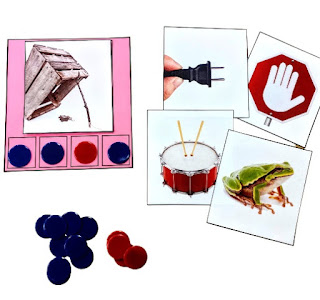
How do we use sound boxes? When we are just starting out, learning to segment sounds orally, we use our sound boxes with colored chips. I give each student 2 colors - one color for consonant sounds and another color for vowel sounds. We segment the word orally, pushing a chip forward for each sound. For example, "fan" would be /f/ /a/ /n/ and we would push forward 3 chips. then we tap each chip in turn, saying the sound that it represents again:  /f/ /a/ /n/. And then, we swoop our finger from left to right and blend the sounds back together to say the whole word: Fan!

Once we know how to orally segment words into individual phonemes, and we have a good grasp of letter-sound correspondence, we move from using colored chips to using plastic letters! I like to use Learning Resource's lacing letters because there's 275 in a pack so I have enough for everyone in my small group, plus they're all lower case!


We follow the same steps as before - orally segmenting the word and counting the sounds. Then we say each sound separately and identify it "Bug, /b/ /u/ /g/. The first sound, /b/, is spelled with a b. The second sound /u/ is spelled with a u. The last sound, /g/ is spelled with a g." Once we have each letter on the card we say the sounds again and blend them together to make the word: Bug!
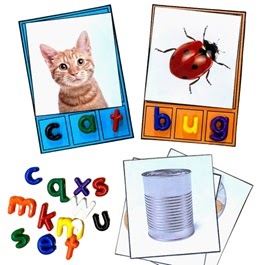
This has been amazing for my students - not only for their reading, but for their writing too! Being able to segment and blend phonemes is a foundational skill for both reading and writing - and its amazing when you can hear students doing it independently, whether while writing in their journal or while reading a Mo Willem's "Elephant and Piggie" book from our classroom library!

And the best part? When we use REAL PHOTOS, we are building our vocabulary! This is especially powerful for my English Language Learners! I don't know about you, but a lot of times I am puzzled by clipart, but there's no guesswork when using photographs! 
And of course, you don't stop at CVC words! You can use sound boxes for CCVC and CVCC words too!
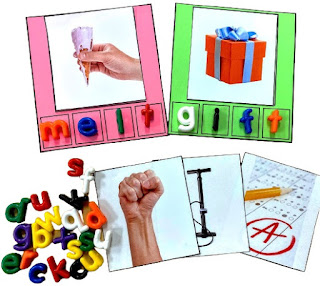
But wait, what about CVCE words?? Yep, sound boxes are effective for those words too!


We use the same familiar process - segmenting each sound and then representing them with either chips or letters. Since the "e" is silent, it doesn't get its own box, but instead snuggles in next to the last consonant. This year, after using the sound boxes, it was so much easier for my students to remember to read the long vowel sounds in CVCE words correctly and to use the silent e in their writing.

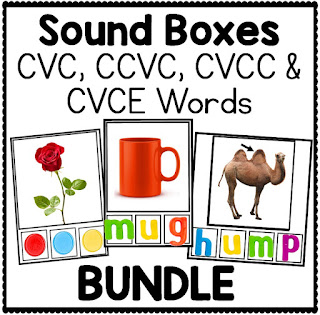
If you're interested in trying out sound boxes in your  classroom, you can grab the bundle with CVC, CCVE, CVCC & CVCE Words here:


Orthographic Mapping

What is Orthographic Mapping and why is it so important?

      Hello! You may have noticed that this blog has taken a backseat lately! There's a very good reason for that! You see, last Spring I started working on my Master's of Education in Literacy from American College of Education. Now, I have to admit that in terms of workload, this has been easier than I anticipated - I'm not drowning in homework, but neither am I living a life of leisure. I'm still teaching kindergarten full time, plus I have 3 boys at home. Teaching, schoolwork, and family were my priority (not in that order!) so I had to let my blog rest for a while.      
    The reason I decided to go back for my Master's was to help me become better at teaching reading. I've known for a while now that some of the things teachers are doing in the classroom (me included!) were not optimal. Teachers always say "When you know better, you do better." but it takes a concerted effort to try to "know better"! The reason I decided to go back for my Master's was to help me become better at teaching reading. I've known for a while now that some of the things teachers are doing in the classroom (me included!) were not optimal. Teachers always say "When you know better, you do better." but it takes a concerted effort to try to "know better"!      

    I love teaching Math and Science - those are my jam and I understand how to build a solid foundation for my students in those subjects. I am confident that my students leave my classroom with what they need to know in those areas. My aim in getting a Literacy degree was to "know better" and become just as confident in teaching my students to read and write. And guess what?! I'm a week away from finishing my program and I've learned so much and I'm a much better teacher for my students as a result! I've been able to implement changes in my classroom throughout this school year, and the results have been so encouraging. That's why, when I was assigned to come up with an original, open-ended project, I immediately decided on writing a blog post so I could share some of this journey I've been on. 

    As I thought over all of the things I could write about, it became obvious to me that the most significant change I have made in my classroom has been orthographic mapping:  


                     One of the most difficult aspects of learning to read is learning to process graphemes accurately, automatically, and quickly (Ehri, 1987). It's a skill that distinguishes good readers from bad readers, and in my experience, this is a skill that many kindergarten students struggle with. 

    So now that we know WHAT orthographic mapping is, how do we get our students to DO it?


   As this chart displays, orthographic mapping occurs when students have sufficient letter-sound knowledge AND Phonemic Awareness proficiency. My takeaway from this is that I need to teach phonemic awareness skills explicitly and systematically. I’ve also spent a lot of time figuring out the best way to do this and decided that, for me, it’s by doing the daily Heggerty Phonemic Awareness Lessons. I do this as a whole group, and it only takes about 10 minutes a day! Heggerty gives me the biggest return on my instructional time – we hit so many skills during that 10 minutes, from basic rhyming and beginning sound to the more advanced skills of deleting and substituting phonemes! Our PTO was kind enough to buy this for my classroom, but since it’s only $89 and you can use it year after year, I think it’s worth it to buy it yourself if you can’t get your admin or PTO to purchase it for you. 

    Once your students can HEAR the sounds in spoken language and are learning grapheme-phoneme correspondence, it's time to start decoding. Interestingly, according to Dr. Kilpatrick (2015), reading practice can either be the key to becoming a better reader, or it can have very little benefit. Doesn't that just go against everything we've believed for so long?! For children who can orthographically map, reading practice is essential, but if a child cannot orthographically map then all the reading practice in the world will not make a difference. First, they need to develop phonemic and letter-sound proficiency so that they can start orthographic mapping (Kilpatrick, 2015).

    One of the BEST ways I have found for teaching students to orthographically map are the FREE Heart Word videos from Really Great Reading. So far there are only 26 videos, but they are working on more. However, using their format to introduce irregular words has helped my students to not only be able to READ these words, but also spell them correctly in their writing.! 
    

    As Scarborough's Reading Rope conveys, skilled reading is made up of multiple facets that are interdependent. Explicit, systematic instruction in phonics is a MUST, and orthographic mapping will flow out from that. 

    But what do we do for students who get stuck and cannot develop the skill of orthographic mapping? I'll address that next time, when I share some more of what's been working in my classroom! 


References:
Ehri, L. C. (1987). Learning to Read and Spell Words. Journal of Reading Behavior, 19(1), 5–31. https://doi.org/10.1080/10862968709547585 
Ehri, L.C. (2005). Learning to Read Words: Theory, Findings, and Issues. Scientific Studies of Reading, 9, 167 - 188. https://doi.org/10.1207/s1532799xssr0902_4 
Ehri, L.C. (2014). Orthographic mapping in the acquisition of sight word reading, spelling memory, and vocabulary learning. Scientific Studies of Reading, 18, 21 - 5. https://doi.org/10.1080/10888438.2013.819356 
Kilpatrick, D. A. (2015). Essentials of assessing, preventing, and overcoming reading difficulties. Scarborough, H. S. (2001). Connecting early language and literacy to later reading (dis)abilities: Evidence, theory, and practice. Guilford Press. In S. B. Neuman & D. K. Dickinson (Eds.), Handbook of early literacy research (Vol. 1, pp. 97-110). 
Stroop, J. R. (1935). Studies of interference in serial verbal reactions. J. Exp. Psychol. 18, 643–662. doi: 10.1037/h0054651

Popular Posts