Incorporating STEM in Kindergarten

STEM Ideas for Kindergarten using Nursery Rhymes

I think my most popular session at SDE's I Teach K was my "S.T.E.A.M.ing Through Nursery Rhymes"! It's such a hot topic right now, but there isn't a whole lot out there for making it truly accessible in kindergarten. Today I'm going to share a little bit of that session with you!
 
One of my favorite ways to incorporate technology into teaching nursery rhymes is by using a Green Screen app!  I use Green Screen by Do Ink on my iPhone, it's $2.99 in the App store. Here's a quick clip of my son, Sullivan, reciting Baa Baa Black Sheep.


I simply hung a piece of green felt on my wall and googled a picture of a sheep in a field. Sully was totally not into being filmed (I bribed him with Dum Dums, if you look he has two fistfuls!), he hates the flash on my camera so even when I promise him it won't flash he tends to look away anyways. However, once he saw the finished product with the sheep behind him he was enthralled! He wanted to do it again and again and kept asking to do different rhymes to see what would pop up behind him! It works the same with students! They LOVE seeing themselves on screen, and putting together some video clips of students reciting nursery rhymes is a great way to start an Open House or Parent Teacher Conferences!

Engineering challenges can be hard in Kindergarten! Their little fingers may have difficulties manipulating the materials, so often we call in our 5th grade friends for help. However, I like to start the year with a challenge they can complete on their own so they have some experience before calling in older helpers. I find this gives them more confidence in their ideas, so its not so much the 5th graders leading the challenge as being directed by the Kinders. One of the easiest engineering challenges for Kinders is this Building a Tuffet challenge for the Little Miss Muffet rhyme.
https://www.teacherspayteachers.com/Product/Little-Miss-Muffet-STEM-Nursery-Rhyme-Unit-2703104?aref=moq04rds
This challenge requires just some paper towel rolls, tape, glue and construction paper, along with a doll or two to play Miss Muffet!

https://www.teacherspayteachers.com/Product/Little-Miss-Muffet-STEM-Nursery-Rhyme-Unit-2703104?aref=moq04rds
I have my kinders work in groups, but you could easily have them complete this challenge on their own as well. You can see that there were several different ideas for creating the "tuffet"!

Incorporating art into nursery rhymes is easy, but I always try to move away from simple crafts to actual process art. For our Tiny Tim nursery rhyme we used different sizes of bubble wrap to paint our turtles and the kids loved it!
https://www.teacherspayteachers.com/Product/Tiny-Tim-Turtle-STEM-Nursery-Rhyme-Unit-3210042

Tying in math concepts is easy with some of the nursery rhymes. For example, for Hickory Dickory Dock we combine retelling with learning to tell time! I made this clock out of a cereal box and the mice from felt.  As we retell the nursery rhyme, we use a different clock face and change the time in the rhyme!

https://www.teacherspayteachers.com/Product/Hickory-Dickory-Dock-STEM-Nursery-Rhyme-Unit-3246160

And of course we can't forget the Science aspect of S.T.E.A.M.! I incorporate a demonstration or experiment with each of my nursery rhyme units:

Like this demonstration on what fire needs with the rhyme Jack Be Nimble  - perfect for Fire Safety in October!

https://www.teacherspayteachers.com/Product/Humpty-Dumpty-STEM-Nursery-Rhyme-Unit-2845344
Or an experiment on gravity for Humpty Dumpty using sand, flour and marbles! 

Another way that I incorporate STEM ideas in my classroom is through our center materials. I have so many different types of building materials from blocks to magnetic tiles to 3d shapes to natural wood pieces to plastic cups! You'd be amazed at what the kids can build with these materials! However, while I was at I Teach K this summer I saw a great, new product at a booth and had to have it! 
https://www.amazon.com/Blocks-Rock-STEM-Building-Educational/dp/B005D1HQ9Y/ref=sr_1_1?ie=UTF8&qid=1503255172&sr=8-1&keywords=blocksrock
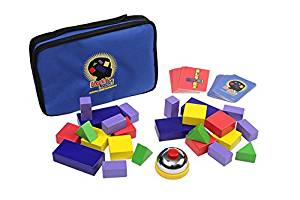
Meet BlocksRock. This product was created by a group of 6th graders! It comes in a handy, zippered carrying case for easy clean up and storage. It includes 2 levels of cards along with a bell. There's a free app that extends the fun even more!
This is me with at the BlocksRock booth at I teach K with their incredibly friendly staff!
Angie from BlocksRock was gracious enough to allow me to try a set out for myself. I brought it home and started playing it with Sullivan. Since he's only 4 and his spatial awareness is still developing, I allowed him to build at his own pace rather than racing against me.

He loved being able to ring the bell when he was finished! Initially he played for 20 minutes straight, which was awesome for a 4 year old's attention span! We've played with the set several times in the past month and I can already see a big difference in his ability level. We started with the Level 1 cards and he is now able to easily complete the Level 2 cards and even some of the Level 3s! 

Here's a picture of what I built with the app!

I took my set to my first day of in-service training and soon had all of the teachers playing it too! Our 3rd grade teacher is using some leftover grant money to purchase some sets! You can buy them either through the BlockRock website or on Amazon (affiliate link) There's a discount for buying 2 sets, and if you buy 5 you get a set free! These are perfect for after school Science Clubs, STEM Nights or even in your classroom Block Center! I honestly can say that this product can go from Pre-K all the way to at least 5th grade in a classroom setting. Not only has Sullivan played it, but my 10, 13, and 18 year old kiddos also tried it out and enjoyed it! I even got my 18 year old to put down her phone for a full twenty minutes to play it with me!

Want to win your own BlocksRock set AND your choice of one of my Nursery Rhyme STEM packs? Enter this Rafflecopter drawing for your chance to win! 

Three ESSENTIALS For Math Center (FREEBIE)

Setting up Math Centers in Kindergarten


At my Fun-tastic Games & Activities for Building Early Math Skills session at SDE's I Teach K in Vegas I presented about some of my favorite Math Centers. Oriental Trading Co. was generous enough to sponsor some giveaways during the session for items that I use in my centers, so I wanted to give a shout out to them, they always have great, inexpensive materials for my centers! Today I'm sharing a little bit from that session, to give you some math center ideas for kindergarten that will help save you time and make your Math Centers more engaging this school year!

One of my biggest Aha! moments was when I realized that it was way easier to change the CONTENT of a Math Center rather than having to teach a whole new set of rules/procedures each time because I changed the activity. Today I'm sharing the 3 essentials for my math centers - I change up the themes frequently, and differentiate the skill level or content, but once I teach my students how to use these essentials, I'm set for the year! I can change the look of the games and my students' engagement is renewed, yet I'm not wasting time teaching how to use new materials!

#1 Dice

https://www.teacherspayteachers.com/Product/Math-Centers-for-Dice-and-Playing-Cards-3332258
I love dice because they're so versatile, and you can get so many different kinds - dice with numbers, dice with dots, dice with shapes, dice with 6 sides all the way to 20! Once I teach my students the rules of using our dice (shake once, roll gently, keep dice on the table) we are good to go with whichever dice fit our game! One of the first games I introduce is Roll & Cover. I love this because depending on the mat and dice you use, students can be practicing one to one correspondence, number recognition, shapes recognition, addition or subtraction! When we introduce addition, students play with 2 dice, adding them together and finding the sum.
https://www.teacherspayteachers.com/Product/Math-Centers-for-Dice-and-Playing-Cards-3332258
 Later in the year, my students play with 3 dice, adding them all together for sums up to 18!

https://www.teacherspayteachers.com/Product/Math-Centers-for-Dice-and-Playing-Cards-3332258
When we introduce subtraction, the game play changes slightly so that they roll the dice and subtract the smaller number from the larger number and find the difference.

We also use our dice to play Ten Frame Fill-Up! In this game, each child rolls a dice an places that many tokens onto their ten frame, filling them from top to bottom, left to right.  The first one to fill up all 3 ten frames and reach 30 wins!  
https://www.teacherspayteachers.com/Product/Math-Centers-for-Dice-and-Playing-Cards-3332258
For all of these games, we just use dice and tokens from Oriental Trading Company. They have these round, colorful stacking blocks that are perfect to use as tokens - they come in a ton of colors and with 400 to a pack, there's enough to even split a pack with a teacher friend!

https://www.teacherspayteachers.com/Product/Math-Centers-for-Dice-and-Playing-Cards-3332258
 We also use Geometric Dice from Oriental Trading to play Roll & Cover with shapes, and even Roll & Graph!
https://www.teacherspayteachers.com/Product/Math-Centers-for-Dice-and-Playing-Cards-3332258

#2 Dominoes

I also love using dominoes in the classroom - they're great for one to one correspondence, subitizing and more! They're inexpensive so I've even had some luck with asking parents to donate a set or two to the classroom (in case you need ideas for a Wishlist!). My students love my Domino Math pack too!

https://www.teacherspayteachers.com/Product/Math-Centers-for-Dice-and-Playing-Cards-3332258
 Creating number bonds is easy with dominoes!

https://www.teacherspayteachers.com/Product/Math-Centers-for-Dice-and-Playing-Cards-3332258
We also use dominoes when comparing numbers!


https://www.teacherspayteachers.com/Product/Math-Centers-for-Dice-and-Playing-Cards-3332258
I use them to help students learn vertical addition as well!


#3 Playing Cards

Playing cards are a must-have for Math Centers because there are so many no-prep games you can play with them! Go Fish is an easy game for number recognition for example. (I get my playing cards donated by the local casino, so that's why there are holes punched in the cards.) You can have your students sort them, place them in numerical order, even create 2 or 3 digit numbers!

https://www.teacherspayteachers.com/Product/Math-Centers-for-Dice-and-Playing-Cards-3332258 
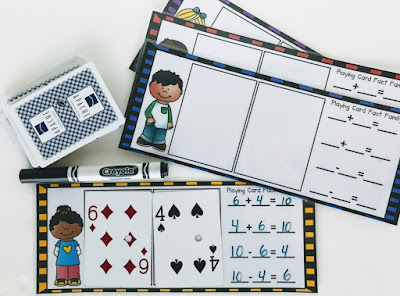
I love using playing cards for fact families. Just draw two cards and the students write the addition and subtraction equations to match! Using the cards means that if students get confused they can count the shapes on the card, so it supports my lower students. 


https://www.teacherspayteachers.com/Product/Math-Centers-for-Dice-and-Playing-Cards-3332258
Comparing numbers is easy with cards as well - just remove the face cards!

With these 3 inexpensive items, you'll easily cover all your Math Skills throughout the year! Your students will also love getting to "play" with dice, dominoes and playing cards, so they'll remain motivated and engaged during centers - it's a win-win! All of the above games can be played easily with a whiteboard and dry erase marker, but if you'd like to grab my Math Bundles to make it easy on yourself, you can see them here: Math Centers for Dice and Playing Cards  and Domino Math!

https://www.teacherspayteachers.com/Product/Raccoon-Themed-Roll-Cover-Number-Recogntion-Sampler-Pack-1909046
Visit my store and grab this Roll & Cover Sampler pack for FREE - perfect to go with The Kissing Hand!


Activities for the First Day of Kindergarten

Fun and simple ideas for the first day of kindergarten

The first day of school can be stressful - for both teachers and students! Here are my tried and true first day of kindergarten activities to make your day go smoothly!


The first thing I focus on with my kindergarten students is teaching Routines & Procedures! I cannot stress enough how important it is to take the first 2 weeks of school and devote it solely to teaching Routines & Procedures. This will be the foundation of your whole year. Teach your students what is expected of them and how to function in your classroom and you will reap the benefits ALL YEAR LONG!

But, which procedures should you teach first? Have you heard the saying "Maslow before Bloom"? The first day of kindergarten is when you have to make sure you take care of your students' needs and anxieties so that you can eventually start teaching them. In my experience, almost every  student will come in on the first day of kindergarten WORRIED ABOUT THE SAME 3 THINGS! It will save you so much heartache and hassle if you address those 3 issues FIRST! And the BONUS is that you can turn taking care of these NEEDS into engaging activities for the first day of kindergarten that will make your students happy and comfortable in your classroom!

#1 How do I get home?

When their parents walk out the door on that first day, our students immediately begin stressing about the end of the day! How will their parents find them? At what point will they be able to get out of this place? What happens if their parent forgets or gets lost? What about taking the bus - how will they know which bus or daycare van to board? It is super important to ease that anxiety, and if you start your first mini lesson with "Here's what we're going to do at the end of the day to make sure you get home." I GUARANTEE you will have every one of your students listening raptly!

https://www.teacherspayteachers.com/Product/How-Do-We-Go-Home-Emergent-Reader-Song-Graph-More-3297452


Now, this doesn't mean that you need a big long lesson about ways to get home. I sing a song about the different ways we go home, and use some felt board pieces as I sing. Then we do a simple pictorial graph where each child colors an icon about the way they get home and adds it to the class graph. Later on in the week we'll continue the lesson with an emergent reader and then we'll create our first Class Book! Tip: make sure parents fill out the going home info at your Back To School Night, so if a child is unsure, you can refer to your list! Here's an example of our "How Do We Go Home?" graph - I always have my students color their picture and write their names on the back before adding it to the graph.

https://www.teacherspayteachers.com/Product/How-Do-We-Go-Home-Emergent-Reader-Song-Graph-More-3297452


At the end of this first mini lesson, you have your first class graph to display, which you can refer to throughout the week - counting how many students walk home versus ride the bus etc. So you're incorporating your first Math Standards at the same time as alleviating their Number 1 Fear! Later on in the week we'll continue the lesson by having each child color their own emergent reader to take home and read, and then we'll create a class book where every child gets their own page!
https://www.teacherspayteachers.com/Product/How-Do-We-Go-Home-Emergent-Reader-Song-Graph-More-3297452


https://www.teacherspayteachers.com/Product/How-Do-We-Go-Home-Emergent-Reader-Song-Graph-More-3297452
  Grab all of these activities in my How Do We Get Home? pack!

#2 Where's the bathroom?

The next thing you'll need to teach, because at this point in the morning it's going to be a NECESSITY, is Bathroom Procedures!  At the beginning of the year, kindergarten students have bladders that are about the same size as a Chihuahua's. As the year goes by, you'll be able to train them to "hold it" for longer periods and to almost go "on schedule" but at the beginning of the year, that potty sees a LOT of use! And of course, to 5 year olds, knowing where the bathroom is and preventing embarrassing accidents, is high on their list of anxieties. 

At this point I quickly go over how we ask to go to the bathroom, what terminology we use (because no one wants to hear "I gotta poop!"), where it is and what we do inside the bathroom - and what we don't do! If you have a single classroom bathroom, your procedures will vary from those who have to walk the entire class down the hall to the bathroom. 
https://www.teacherspayteachers.com/Product/Hand-Washing-Procedures-Reader-Poster-and-Sequencing-Pocket-Chart-3292633?aref=jxilj01d
In my class, we talk about closing the door, wiping, flushing, and hand washing. I actually demonstrate our handwashing because it makes me cringe to see children get a handful of soap and then stick their hands under the tap and rinse it all away before they even had a chance to lather up! I created a Handwashing Procedures Pack which includes pocket chart sequencing pieces, a poster to hang by the sink, a printable b&w reader and a cut and paste sequencing sheet. 
https://www.teacherspayteachers.com/Product/Hand-Washing-Procedures-Reader-Poster-and-Sequencing-Pocket-Chart-3292633
 

 # 3 Am I going to get fed?

After you've taken care of their most pressing biological need, its time to focus on their stomachs! Every child wants to know when they will be fed! It's especially important in Title I schools, where some children may not get regular meals at home, to reassure children that you WILL feed them every day. Once you've covered that basic fact, you'll have to go over Cafeteria Procedures because it's a totally different experience than they're used to from eating at home. 99% of your students  have never held a tray in their lives. Don't let the first time be when it's full of food and a milk carton AND they're attempting to walk AND find their seat in the cafeteria! That's just going to lead to disaster (and extra clean up for your custodians!). I have an EDITABLE Cafeteria Procedures FREEBIE for you too!


I play the Cafeteria Procedures powerpoint on my Smartboard and we discuss each slide. If you don't have a Smartboard, print each slide and show them to your students as you discuss the different points. Also, talk with your cafeteria staff beforehand and get a few trays to practice with. Ask if they'll let you do a "dry run" of the salad bar/cafeteria so your students can see it all beforehand. Ask your Special Ed, Speech and Counseling coworkers who aren't yet pulling their students to come down and help out with the first couple of lunch periods. Game Changer Tip: when your students get their lunch trays, lay their milk down on its side rather than standing it upright! We tried it last year and we had fewer dropped trays without that unwieldy milk carton causing issues!

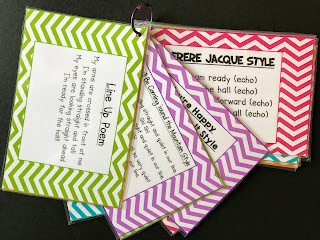
Once you've gotten through these first 3 activities for the first day of kindergarten, it's probably time to teach your students how to line up and walk in the hallway. Don't forget to grab your FREE Line Up Chants - they make lining up a treat! I put mine on a ring and hang them by the door so we can choose a new one periodically - keeping it novel means that your students are more likely to pay attention!


https://www.teacherspayteachers.com/Product/FREE-Transition-Songs-for-Lining-Up-1940028?aref=b6zh5ls1

Using these activities for your first day of kindergarten is sure to make your day go smoothly! And chances are, if you can start your school year with a good first day, the rest of your year will follow suit! Being sensitive to student needs is the best way to build good relationships with your students and create a warm and welcoming classroom community!

Popular Posts