Tips for setting up a safe and efficient classroom
When trying to set up your classroom for your Play-Based Learning centers, there are 5 Essentials to take into consideration. Ignoring these 5 Essentials leads to the Top 5 Complaints about Centers. Cut critics off at the pass by thinking about these things BEFORE you set up your classroom!
Noise: Let's face it, a kindergarten or Pre-K classroom is going to be noisy - especially at Center Time! However, some Centers lend themselves to noise more than others like Block Center and Dramatic Play. On the other hand, Listening Center and Reading Center are quieter activities. Put a noisy Center next to a quiet Center and you can almost guarantee that the quiet Center is not going to work out - the students will be too distracted by the noise from the next Center to concentrate! So before you start setting up your room, make a list of your Centers divided into 3 categories - Noisy, Quiet and Moderate. Then make sure that the moderate noise Centers act as buffers - between 2 noisy centers (because noisy+noisy=out of control!) and between noisy and quiet Centers. Your noisiest Centers should also not be near your classroom door - unless you plan to keep it closed at Center Time!
Space: There's never enough of it, and it's hard to decide which Center gets it and which doesn't. Obviously Block Center needs a lot of space, but does that mean Writing Center should get shorted? Ideally you wouldn't ever have to make that decision, but since we live in the real world, we do. My solution is to make certain Centers portable. With the weight of hardwood blocks, obviously Block Center can't be moved around the room, so that's a permanent Center. Your Listening Center needs to be located by an outlet and plugging it in and unplugging it daily would likely be a hassle so that's a permanent Center. Same with Reading Center - unless your Library is on wheels, you're going to want to keep that set up all the time. Once you've decided which Centers HAVE to be permanent, you can then look at ways to make your other Centers portable. I have a weird cubby space by the door to my heater/air conditioner. I can't block access to that door, but I CAN put a rolling table in that space. At Center time that table rolls out with our Dollhouse on top and can be moved anywhere in the room. At the end of Centers it is a snap to roll it back into place! Similarly, our Puzzle Center and Play Dough Center are stored in bins on shelves during the day - come Center Time they're moved to a table top. If you train your students to help setup and put away these portable Centers, it takes just a few minutes to have them ready or cleaned up!
Mess: Center Time can be messy, it's part of the exploration and learning that students are doing. That doesn't mean your room has to be a wreck though. Keep your Art Center and Sensory Center on tile if possible or place a plastic tarp under them if you have wall to wall carpet. If you're lucky enough to have a sink in your room, obviously your Paint Center will need to be close to it. Make sure you have the tools for students to clean up their Centers too. We have 3 sets of dustpans and brushes sized just right for little hands. Part of our clean-up routine is sweeping the floor around Play Dough Center & Sand & Water Center. When water play is involved, I provide a basket of rags for wiping up spills. This helps to keep accidents down since slip hazards are removed plus it helps teach the students responsibility! Bonus? The custodians don't complain about my room!
Traffic: Have you ever noticed that on an open stretch of highway you tend to increase your speed? The same thing happens in the classroom - any time there is an opportunity to move in a straight line, students are going to run. Although we as teachers love nice, straight aisles, it's going to be a behavior problem at some point, because that wide open space is too tempting. Try to make sure that while there is space to get to the exits, there are no runways for students to build up speed around the classroom. Place a bookcase or table in the pathway to act as a speed bump so students have to slow down!
Behavior Management: Students can get bored of playing with the same toys day in and day out. A bored student can be a disruptive or destructive student! Once they have explored all of the acceptable ways to interact with a toy, they move on to the unacceptable ways! In order to prevent this, consider how you can switch out Center materials so that they remain "fresh" in the students' eyes. This may be as simple as changing out Roll & Cover game boards in your Math Center, or rotating books in Reading Center. Add a wooden train set to Block Center or new cookie cutters to Play Dough Center. And of course, don't put out every single activity on Day1 - start out with a few things, then after a couple of weeks add in some more. Take something out and add something different. If you keep switching it up, chances are students will be so enthralled with the ever-changing activities that they won't have a chance to get bored! Also, keep in mind how many students will be at a Center. If you allow 4 children at a Center, it should have enough materials for 4 so that fighting is kept to a minimum!
If you keep these 5 Essentials in mind when planning your classroom set-up and Centers, your Center Time will be more effective and less stressful plus give your critics less to fuss about! Have another tip? Please Rustle Up a Response below in the comments - I'd love to hear from you!
My friend Maggie over at Maggie's Kinder Corner is hosting an ongoing weekly linky party for Word Work Wednesdays! I'm joining it today to talk about sight words!
There are tons of different opinions on how many sight words to teach, in what order, when to start teaching them etc. Personally, I believe that students need to know all of their letters and sounds before starting on sight words. There just isn't enough visual dissimilarity between a lot of sight words for students to correctly memorize them without having letter recognition.
Once students are ready for sight words, I find that they learn best with their peers. A few students are motivated enough to learn sight words from a list at home, but those are not the majority. The rest need lots of playful repetition - through songs, chants and games.
YouTube has a ton of sight word videos - its just a matter of finding ones with the words you need.
Once of my students' favorite games to play with sight words is always Hide N Seek. You can play this with practically any concept, so once they know how to play, I just change out the cards throughout the year and they practice that skill, or a new skill, without me having to spend more time teaching game play!
The basic premise is super simple - the sight word cards are arranged in a pocket chart, face up. One student hides a small picture behind a card while the other students close their eyes. Then they have to "find" the small picture by guessing which card it is hidden behind. They can't just point, they have to read the word or the Hider won't turn the card around. Since this can be played in small group, there is always someone who can reinforce a word or correct a misread word. And I make multiple picture pieces so that game play can be extended - if they have to find all 3 pictures they generally read a ton of words before they find them all!
Generally, I group together students who are within a few Dolch Word Lists of each other. I use the Dolch Word Lists because there are so many resources for it, as compared to the sight word list my school uses. The two word lists have almost exactly the same words, except in different order, so if students master the Dolch Word Lists, they can generally read all the other sight word lists out there!
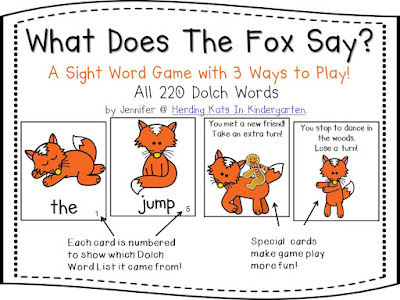
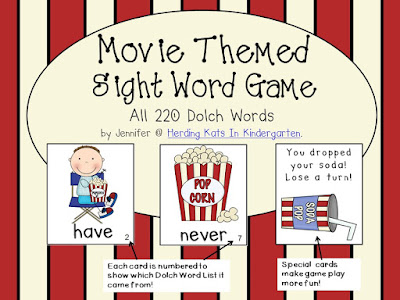
I've created many different themed sets of Sight Word Games. Each time I change out the cards, my students act like its a totally new game and enthusiasm revs up! Here are some of the different theme I have - check out my TPT store for more!
Playing games, watching videos and singing chants helps my students learn the sight words in ways that are engaging and fun! Plus, I don't have a ton of worksheets to grade or papers to copy! Just create the game and let them play!When I do my required sight word assessments, I always see growth, so I can justify letting my students play games rather than tracing worksheets!
I hope that gave you a few ideas for making learning sight words more fun for your students! Head on over to the linky to see what other bloggers are talking about for Word Work Wednesday!
Do you have to teach positional words? Positional words can be very tough for ELL students and for those students who have not been exposed to a wide vocabulary. It's one of those skills that I struggled with when I first started teaching, because it seemed so easy to me that it was hard to understand how my students could NOT know what "on" or "under" meant and that I would have to explicitly teach these words! My own children knew these words way before they were school aged, simply because of all the conversations we had - "Your car rolled under the couch, reach under and get it!" or "Leave your cup on the table while we wipe your hands." or "Put your bear on the shelf next to your books." Obviously ELL students haven't had these experiences, but since I teach at a Title I school, I see many, many students who are not ELL who still don't have this vocabulary experience.
So now I explicitly teach positional words as part of my Morning Meeting or Calendar Time. I have a few favorite positional word videos:
I also use my Kohl's Cares animals that are usually in our Reading Center. I usually choose a few students a day to move our animals around the room. At first, I instruct the children as to where to put the animals - "Put the dog on the table." or "Can you fit the monkey under a chair?"
As the children get more comfortable with positional words, I start having them decide where to put the animal and then tell the class where it is using positional words - "The bear is in front of the door." or "The bear is between the caddies."
Showing a video and having students manipulate the animals literally takes only 5 minutes a day and my students LOVE it. The fun of getting to get up and put the animals in silly places means that this is a highly engaging activity - both for the student holding the animal and their friends who are watching and giggling up a storm! And because it works so well whole group, it's a skill that I don't have to focus on in small groups!
Simple right? Math often is - it doesn't always have to be a big lesson with worksheets and assessments! Now head on over to Kinder Kraziness to read some more Math Monday goodness!